Bodybuilding is a multi-phasic sport, and most of the progress that shows on stage is built in the phases that receive the least attention: improvement season, pre-prep, and recovery. Understanding how these phases function, and how much time each one actually requires, changes how a career in the sport is structured from the first season onward.
Contest prep is an exposure phase, not a progress phase. It reduces body fat and reveals the muscle, structure, and conditioning capacity that already exists. The muscle itself is built during improvement season, which operates on a timescale of 12 to 24 or more months and requires sustained energy availability, progressive training across multiple mesocycles, and adequate recovery capacity. Pre-prep, typically 4 to 12 weeks, brings starting body composition into a range where the rate of loss through prep can be controlled, which directly governs muscle retention. Post-show recovery, typically 8 to 12 weeks, determines the physiological state an athlete enters improvement season with. Most competitors underweight these phases relative to prep, and the stage outcomes reflect it.
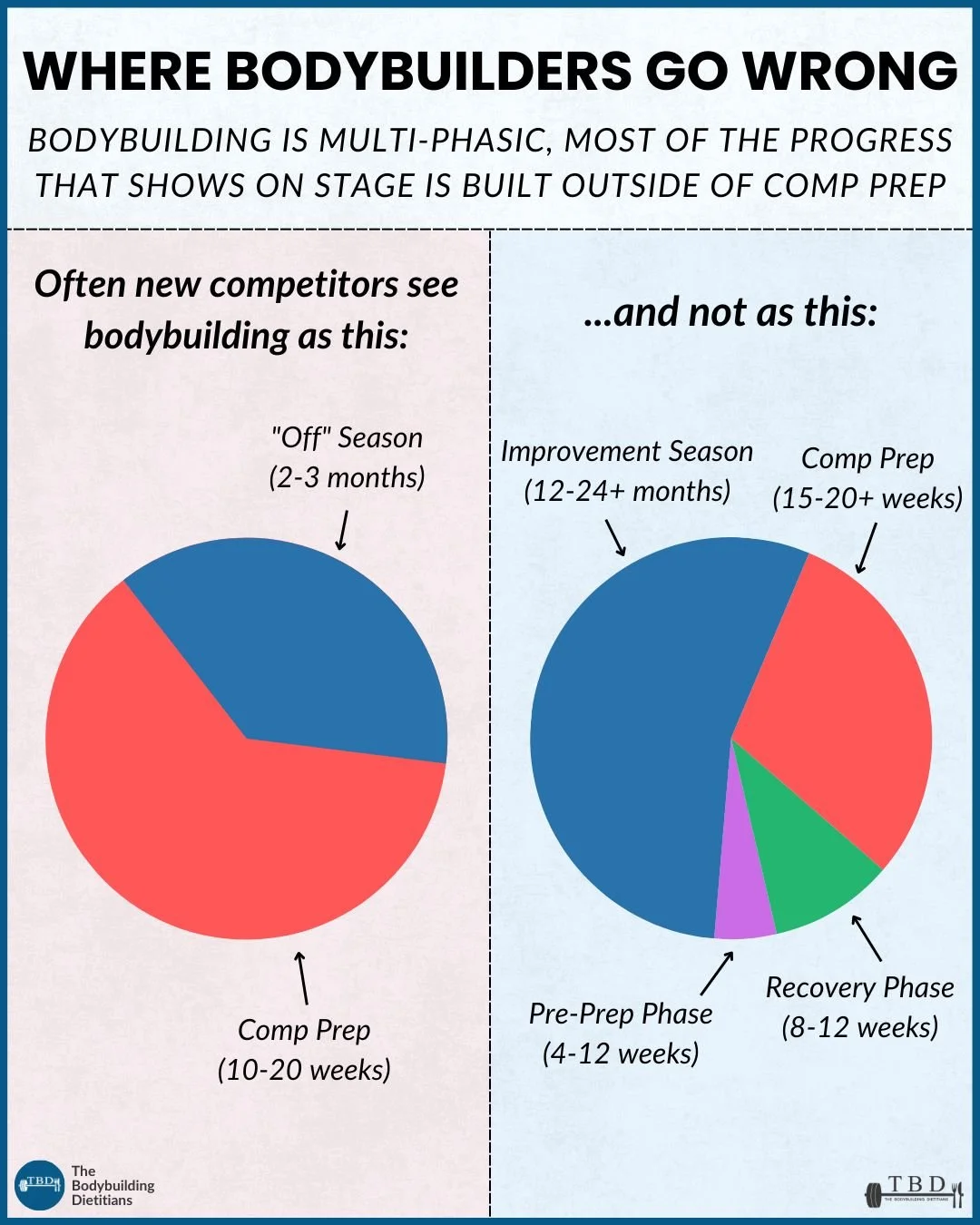
The most common misunderstanding in competitive bodybuilding is about which phase is responsible for producing stage-ready physiques. For many competitors, particularly those early in their career, the focus of attention and effort sits overwhelmingly on comp prep. It makes sense on the surface: prep is where visible change happens fast, where the diet is most structured, and where the competition date creates urgency and clear accountability.
The problem is that prep is not primarily a phase for improving the physique. It is a phase for revealing one. The deficit reduces body fat and exposes the muscle, structure, and conditioning capacity that already exists. If the underlying physique lacks sufficient muscle in key areas, or if the balance between muscle groups is not where the division requires, a meticulous prep will simply expose those gaps more clearly. No amount of prep work changes what is underneath.
The muscle that determines stage outcomes is built in improvement season. The starting condition that determines whether prep can be run at a productive pace is set during pre-prep. The physiological foundation for the next round of improvement is established during recovery. These three phases receive a fraction of the attention that prep does, and they matter considerably more to long-term competitive progress.
What Does Comp Prep Actually Do to the Physique?
Comp prep is a sustained calorie deficit with the specific goal of reaching stage-ready body fat while preserving as much lean tissue as possible. What it produces at the end is a visible display of what the athlete brought into it.
The conditioning process reveals striations, separations, and muscular detail by removing the subcutaneous fat that obscures them. But the depth of those striations, the thickness of the muscle bellies behind the separations, and the overall proportions of the physique are not products of the prep itself. They are products of the training and nutrition work done in the months and years before the prep began.
A competitor who brings a well-developed physique into prep will look more impressive at stage condition than one with less underlying muscle at the same body fat percentage. That gap is not closed during prep. It may become more visible during prep, as both competitors reveal their respective levels of development at comparable leanness, but the gap itself was set long before the deficit started.
This is the functional meaning of calling prep an exposure phase rather than a progress phase. The comparison is not rhetorical. It has a direct practical implication: investing the most structured nutrition and training focus into prep at the expense of improvement season is prioritising the display at the cost of building something worth displaying.
Why Is Improvement Season the Most Important Phase?
Improvement season is where the physique is actually developed. It is the extended period of positive or near-neutral energy balance, progressive resistance training, and adequate recovery that allows muscle tissue to accumulate across multiple training blocks over many months.
Muscle growth is slow. The rate at which trained natural athletes accrue lean mass in a productive building phase is modest by absolute standards, particularly beyond the early years of training. An experienced natural competitor who gains one to two kilograms of lean mass across a twelve-month improvement season has had a genuinely productive year. That increment, distributed across the muscle groups being developed, produces visible improvement at the next prep that no shorter timeline or more aggressive approach within prep can replicate.
Improvement season works on a timescale of 12 to 24 months or more for meaningful structural change, and that timescale is what most competitors underestimate. The competitor who gives improvement season two to three months before returning to prep is giving it a fraction of what it requires. Two to three months is enough to partially restore bodyweight and begin training with some recovered capacity. It is not enough to drive meaningful new muscle accretion that will show on stage.
A genuinely productive improvement season requires sustained energy availability above the level that limits muscle protein synthesis, progressive training structured across multiple mesocycles with appropriate loading and deload periods, adequate sleep and recovery capacity, and a dietary pattern that supports the training demand without the nutritional compromises that a deficit phase requires. These conditions need to be held consistently across many months rather than assembled briefly between prep cycles.
The athlete who competes every six months with two to three months of improvement season between preps is, physiologically, not giving improvement season enough time to work. Their stage physique at year three will look similar to year one because the development phase that determines what prep can reveal has been chronically compressed. The athlete who competes less frequently and invests 18 to 24 months of structured improvement season between competitive appearances will, in most cases, show meaningfully more development at each subsequent prep.
Why Do Pre-Prep and Recovery Matter More Than Their Visibility Suggests?
Pre-prep and recovery are the phases most consistently cut short or eliminated entirely in competitive cycles, and they are the phases whose absence most reliably causes downstream problems.
Pre-prep is the structured transition from improvement season into comp prep. Typically run over 4 to 12 weeks, it brings starting body composition into a range where the rate of loss required through prep is controlled rather than forced.
Starting body composition at the beginning of prep determines how aggressive the calorie deficit needs to be to reach stage condition within the available timeline. When improvement season has produced a higher body fat than is workable, beginning prep directly from that point means the rate of loss required to arrive at stage condition in time is steeper than the rate at which lean mass can be protected. The practical consequence is muscle loss during prep rather than the fat-only loss the process is designed to produce.
Pre-prep resolves this by bringing starting body composition into a workable range before the formal start of prep. A structured reduction of body fat over 4 to 12 weeks at a modest deficit, without the urgency of a competition deadline, places the athlete at a starting point of approximately 10 to 15 percent above projected stage weight, where the subsequent prep rate can be controlled.
The recovery phase follows competition and typically runs 8 to 12 weeks. It is the period during which the physiological cost of the prep is addressed before the athlete moves into improvement season.
A well-executed recovery phase restores hormonal function that sustained restriction disrupts, including luteinising hormone, follicle-stimulating hormone, testosterone, and leptin, all of which are suppressed by prolonged energy deficit and very low body fat. It rebuilds glycogen stores, restores lean tissue volume, reactivates appetite and energy systems that have been suppressed, and allows the athlete to re-establish the dietary pattern and training capacity that improvement season requires.
An athlete who exits a competition and moves immediately into a high-calorie surplus without adequate recovery tends to accumulate body fat rapidly during a period when hormonal and metabolic systems are not yet operating normally. An athlete who manages the recovery phase deliberately, returning to maintenance and then gradually increasing toward a productive surplus as hormonal markers normalise, enters improvement season in a physiologically better position to use those calories for muscle development.
How an athlete exits a show shapes what they bring into improvement season, which shapes what the next prep has to work with. The recovery phase is not downtime, but rather the setup phase for the next two years.
What Does a Well-Structured Bodybuilding Career Look Like Over Time?
The two pie charts in the infographic illustrate the contrast between how many competitors structure their year and how the phases actually need to be proportioned for long-term development.
The common misperception treats comp prep as the dominant phase, with a brief off-season between preps and relatively little attention to the structure of either. An athlete running this model spends most of their competitive years in or near a calorie deficit, with development phases that are too short to produce meaningful muscle accretion and recovery phases that are too compressed to fully restore the physiological conditions that improvement season requires.
The accurate model treats improvement season as the dominant phase across a competitive career: 12 to 24 or more months of structured development work that is the primary driver of career-long progress, followed by a pre-prep phase of 4 to 12 weeks that sets up the subsequent prep to run at a productive rate, a comp prep of 15 to 20 or more weeks that reveals what improvement season built, and a recovery phase of 8 to 12 weeks that restores the physiological foundation for the next cycle.
These are working defaults rather than fixed prescriptions. Individual timelines shift based on starting body composition, training history, age, the demands of the division being competed in, how aggressively previous preps were run, and how the athlete responds to each phase. The competitor entering their first season with less development has a longer improvement season ahead before prep can reveal the physique the division requires. The competitor who has been competing for several years with compressed improvement seasons may need an extended development block before another competitive cycle to close the gap that the compressed timeline has created.
What does not change across individual variation is the underlying principle: the physique that shows on stage is built over years in improvement season, and the phases that make prep possible, pre-prep, and the phases that make improvement season productive, recovery, are not optional components of a well-structured career.
Understanding how to sequence and structure these phases for a specific competitor, deciding how long each one needs based on where the athlete is in their development, and adjusting the structure as they progress through competitive seasons is a central part of how we work with competitors in our bodybuilding coaching.
Practical Takeaways
Contest prep is an exposure phase, not a progress phase. It reveals the physique that improvement season built. The muscle that determines stage outcomes is accrued during improvement season, not during prep.
Improvement season requires 12 to 24 or more months to produce meaningful structural development. Compressing it to 2 to 3 months between preps gives the body a fraction of the time it needs to accrue the lean mass that will show at the next competition.
Pre-prep, typically 4 to 12 weeks, brings starting body composition into a workable range before the formal start of prep. Starting too far above stage condition forces a steeper deficit that compromises the muscle retention the prep is meant to preserve.
Recovery, typically 8 to 12 weeks post-competition, restores the hormonal and metabolic function that sustained restriction disrupts and establishes the physiological foundation for improvement season. How an athlete exits a show shapes what they can build in the next cycle.
The accurate model for a bodybuilding career treats improvement season as the dominant phase and comp prep as a relatively brief revelation of that work, not the primary vehicle of progress.
These timeframes are working defaults rather than prescriptions. Individual variation in starting composition, training history, and competitive history all influence how long each phase needs to be for a specific athlete.
Frequently Asked Questions
How long should an off-season be in natural bodybuilding?
For meaningful structural improvement, improvement season typically needs to run for at least 12 months, with 18 to 24 months producing substantially more development in most cases. The frequent pattern of 2 to 3 months between competitive cycles is not enough time for progressive training across multiple mesocycles to accumulate the lean mass that makes a visible difference on stage. Competitors who compete every six months with short development phases between them tend to plateau in their competitive progress because the development phase is too compressed to drive the change prep is supposed to reveal.
What is the purpose of comp prep if most progress happens outside it?
Comp prep achieves the specific goal of reaching stage-ready body fat while preserving as much of the muscle built during improvement season as possible. Its function is to create the conditions under which the underlying physique can be evaluated at its leanest, which is what competition requires. It does not build muscle or improve proportions. It reveals them. The quality of what prep reveals is determined entirely by how well improvement season, pre-prep, and the preceding years of training have been structured.
What is a pre-prep phase and is it necessary?
Pre-prep is a structured reduction phase run typically 4 to 12 weeks before the formal start of comp prep. Its purpose is to bring starting body composition into a range, typically around 10 to 15 percent above projected stage weight, where the rate of loss required through prep is controlled enough to protect lean mass. When it is skipped and prep begins directly from peak improvement season weight, the rate of loss required to make stage condition within the timeline is often steeper than the rate at which lean mass can be protected, and muscle loss through prep reflects it.
Why is post-show recovery important?
Post-show recovery allows the physiological consequences of sustained calorie restriction and very low body fat to resolve before improvement season begins. Hormonal suppression, reduced metabolic rate, depleted lean tissue volume, and disrupted appetite regulation all take time to normalise after an aggressive prep. An athlete who moves directly from competition into a high-calorie surplus without adequate recovery tends to accumulate fat at a disproportionate rate during a period when the body is still in a metabolically compromised state. A deliberate 8 to 12 week recovery phase that progressively restores intake and normalises physiological function produces a better starting position for improvement season.
Is it possible to build muscle during contest prep?
In specific conditions, simultaneous fat loss and muscle gain during prep is possible, primarily for athletes who are less experienced, returning after a significant break, or at a higher starting body fat percentage where the energy deficit can be partially offset by mobilised fat stores. For more experienced and leaner athletes, prep is most accurately understood as a muscle preservation phase rather than a muscle building phase. The goal is to arrive at stage condition with as much of the muscle built during improvement season intact, not to build new muscle during the deficit itself.
How does training differ between improvement season and comp prep?
Improvement season training is structured around progressive overload across multiple mesocycles, with the primary goal of accruing lean mass and developing the specific muscle groups that represent competitive weak points. Energy availability is sufficient to drive training adaptation, and volume and intensity can be pushed progressively over a long timeline. Comp prep training aims to maintain the training stimulus required to preserve muscle mass during a calorie deficit, with performance managed rather than maximised. Volume may be reduced modestly as the prep progresses and energy availability falls, and intensity measured through RPE is used to ensure working sets remain in the productive range despite lower energy availability.
Sequencing these phases for a specific competitor, deciding how long each one needs based on where they are in their development, and adjusting the structure as they progress through competitive seasons is a central part of what our bodybuilding coaching involves. You can enquire about working with our team or book a consultation to discuss how to structure your next competitive timeline.